

The European Union counts a litany of disastrous errors over nearly the past decade, and it is paying for them now.
The simultaneous ascendance of nationalist and populist currents in the US and across major European powers marks the demise of the post-war West, transforming the European Union into a dysfunctional arena of «national vetoes».
The rise of anti-establishment parties is not merely an ideological realignment, but the direct fallout of disastrous systemic failures, energy deficits, and the erosion of industrial competitiveness, driving economic and social precariousness.
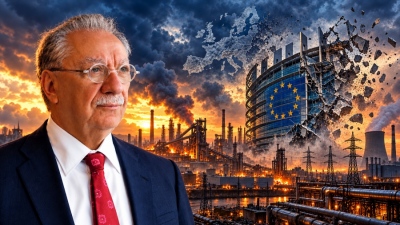
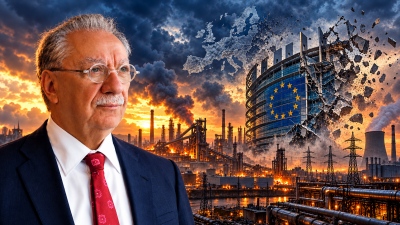
In this emerging, transactional international architecture, Greece finds itself exposed to grave dangers, ranging from borrowing cost increases to pressures across defense and migration, rendering an autonomous, national survival doctrine imperative, as analyzed by Michalis Sallas, Chairman of Lyktos Group, Honorary Chairman of Piraeus Bank, and former university professor.
Nationalism on both shores of the Atlantic
The simultaneous political dominance of nationalist and populist movements across the United States, France, Germany, and Great Britain represents far more than an ordinary rightward swing. It most likely heralds the end of the post-war West as we understood it: an alliance of nations that, despite internal differences, rested upon economic coordination, multilateral institutions, NATO, and European integration.
The re-election of Donald Trump has already shifted the center of gravity of American statecraft toward protectionism and a transactional doctrine of alliances.
The rise of National Rally in France, the electoral consolidation of the AfD in Germany, and the leverage commanded by Reform UK under Nigel Farage in Great Britain round out a wider structural shift.
Even without absolute governing majorities, these political forces already shape the docket on migration, security, Russia, the green transition, and national sovereignty.
The most consequential outcome would not inevitably be the dissolution of the European Union, but its mutation into a Europe of «national vetoes»
National administrations would remain within the bloc, yet they would endeavor to claw back sovereign powers and deploy the veto mechanism far more systematically.
Decision-making on the European budget, sanctions against Russia, defense architecture, EU enlargement, and border policies would grow substantially more intractable.
Without Franco-German consensus, mechanisms for joint debt issuance, banking union completion, and the expansion of the community budget would likewise narrow.
It would be a grave oversight, however, to attribute the surge of these parties strictly to nationalism, migration, or populism.
Across Germany and France, a substantial share of citizens holds establishment parties culpable for the prevailing state of affairs.
Industrial workers, small-business owners, farmers, and production managers observe the cost of energy and basic living skyrocketing, industry hemorrhaging competitiveness, and governments proving unable to shield the manufacturing foundation of Europe.
Establishment parties bear responsibility for degrading the international and geo-economic footprint of Europe
The Russian invasion of Ukraine served as the catalyst for energy upheaval, and Russia cannot be absolved of its own responsibility.
European administrations, however, are far from blameless for what ensued.
Over extended decades, they failed to formulate a serious energy and industrial strategy.
Germany in particular anchored a major portion of its productive model to cheap Russian natural gas, while simultaneously phasing out alternative baseline power generation.
Europe assumed that globalization would perpetually guarantee affordable energy, unrestricted markets, and geopolitical stability.
Well before the rupture with Moscow, the European Union was obligated to diversify procurement sources, invest in grid infrastructure, interconnectors, and gas storage, and structure the green transition with dependable baseload redundancies. It was equally required to formulate shielding mechanisms for energy-intensive manufacturing.
When the crisis struck, it largely substituted relatively cheap Russian natural gas with far more expensive alternatives, while the United States and China systematically backed their domestic manufacturing bases.
The outcome was escalating production expenses, capital expenditure freezes, and offshoring of industrial activity outside Europe
In Germany specifically, the fallout struck the chemical sector, metallurgy, fertilizer manufacturing, glass production, and parts of the automotive complex.
For numerous citizens, therefore, rebuilding functional dialogue with Russia represents not an ideological alignment with the Kremlin, but an economic imperative.
Casting ballots for the AfD or the National Rally frequently functions as leverage to demand a overhaul of energy policy and the safeguarding of domestic manufacturing.
Traditional political parties err when branding these voters wholesale as extremists or anti-European. Unless they acknowledge genuine financial losses and social anxiety, they will continue fueling the very factions they endeavor to contain.
This does not signify a return to the historic relationship with Russia as though the war never transpired
It means Europe requires its own sovereign strategy: deterrence and security, alongside diplomatic vision, cost auditing of its foreign policy choices, and defense of its productive independence.
The forfeiture of industrial competitiveness is not an isolated sectoral handicap.
It endangers the fundamental existence of Europe as an autonomous political and economic pole.
Without strong manufacturing, technological advancement, adequate defense readiness, high-quality jobs, and a solvent welfare state cannot endure.
Simultaneously, American protectionism and prospective European retaliatory tariffs threaten to detonate fresh trade wars.
Financial markets would react to political instability by inflating sovereign yields, especially for heavily indebted member states.
For Greece, such a shift would be far more perilous than it appears
It is an open economy, carries elevated public debt, and depends decisively on European stability.
Degrading shared community policies could elevate Greek sovereign bond yields, curb foreign direct investment, and impact exports, commercial shipping, and tourism.
Inside a Europe driven by national self-interest, wealthier northern capitals could also demand a smaller community budget, slashing funding allocations for regional cohesion and the Common Agricultural Policy.
Equally critical is the question of national security
Within a transactional world order, Greece can no longer take European solidarity or automatic American support against Turkey for granted.
It will be compelled to dedicate greater domestic budget resources to defense, while on migration, tightened border enforcement by northern nations risks trapping populations inside frontline gateway states.
Athens consequently requires robust European partnerships, though not exclusively, alongside energy diversification, defense posture enhancements, debt reduction, and a definitive strategy supporting domestic output.
The core dilemma does not merely consist of the rise of four anti-systemic figures or political organizations.
It is the structural breakdown of a European system that, while properly championing democratic principles and international legality, failed to safeguard economic competitiveness, energy resilience, and living standards for its citizenry.
In short, it failed to protect Europe.
Systemic orthodoxies unfortunately wound up steering the votes of ordinary citizens toward anti-establishment parties to ensure the survival of the European system itself.
Arduous and dangerous paths lie ahead.
www.bankingnews.gr




Σχόλια αναγνωστών